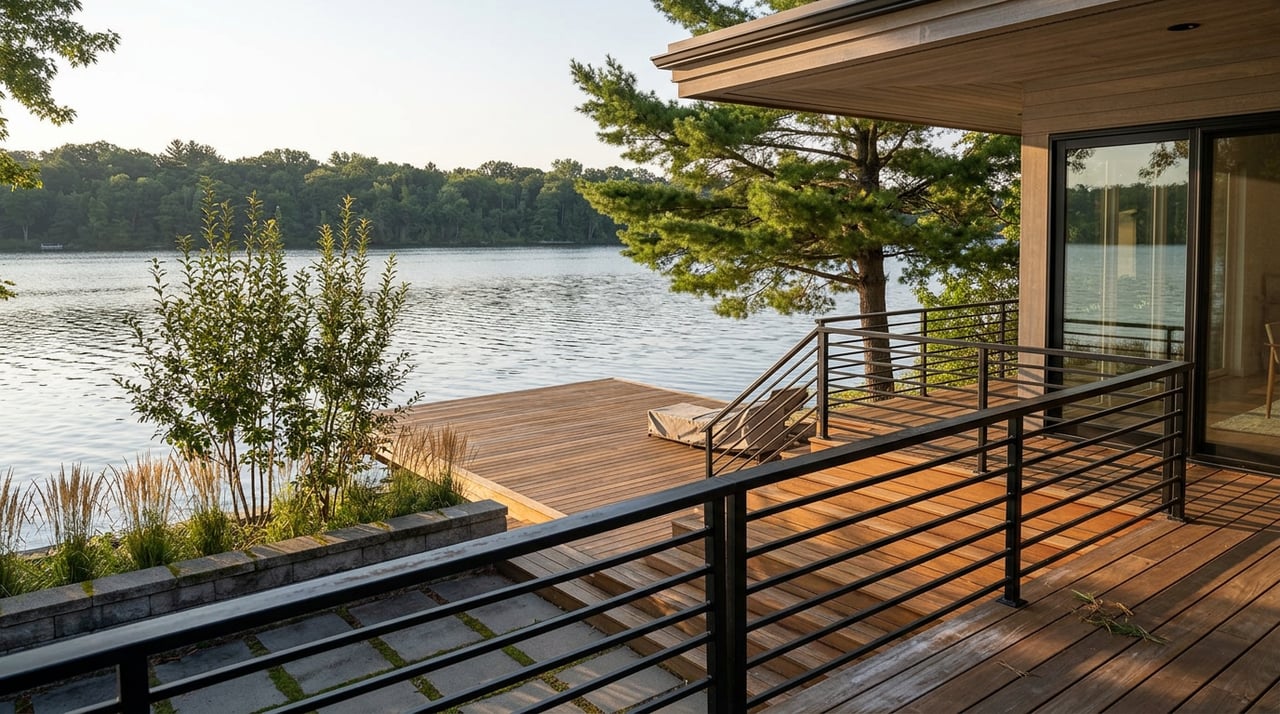
Every June, the same scene plays out along the Chain of Lakes roads outside Elk Rapids. A Bobcat sits in a side yard. Dock sections are stacked on a flatbed. A guy in chest waders checks levels at the shoreline. It is the two-week stretch when a lake property becomes a lake property you can actually use, and it is also, reliably, the moment a new owner discovers that the dock sitting at the end of their lot does not automatically belong to them. Neither does the boat lift. In some cases, neither does the legal right to put a structure there at all.
That surprise is not rare and it is not random. It comes from a specific, well-documented gap in how Michigan treats waterfront ownership, and Elk Rapids sits in a spot where that gap shows up more than most places, because the village straddles two entirely different bodies of water with two entirely different sets of rules.
What "Waterfront" Actually Means at the Closing Table
Riparian rights in Michigan run with the deed. If you own frontage on a navigable lake or stream, you own a bundle of rights that includes reasonable use of the water, access, and the ability to wharf out to navigable depth. That part is settled law and nobody disputes it.
What that bundle does not automatically include is the physical structure already sitting in the water. A dock, a boat hoist, a swim raft: these are separate items with their own ownership history, their own permit status, and sometimes their own maintenance agreement that has nothing to do with who holds the deed to the house behind them.
Buyers hear "riparian rights run with the land" and assume that settles the dock question. It settles the right to have a dock. It says nothing about whether the one currently in the water is legally there, properly maintained, or even included in the sale.
Two Harbors, Two Sets of Rules
Elk Rapids makes this distinction unusually visible, because the village itself manages its public harbor as two separate systems. The Edward C. Grace Memorial Harbor runs 213 slips on East Grand Traverse Bay, a Great Lake. Separately, the Upper Harbor and Upper Harbor II offer 30 and 20 slips with direct access to the Elk River and the Antrim County Chain of Lakes. These aren't interchangeable, and the village runs five separate seasonal waiting lists to keep them straight.
Private waterfront works the same way, just with less signage:
| Grand Traverse Bay Frontage | Elk Lake / Elk River / Chain of Lakes Frontage | |
|---|---|---|
| Governing statute | Part 325, Great Lakes Submerged Lands | Part 301, Inland Lakes and Streams |
| Bottomland ownership | State-held public trust | Riparian owner, to the center thread of the lake or river |
| Public access | Public may walk the shoreline below the ordinary high-water mark, even on private property | No public walking right over private bottomland |
| Permanent dock permit | Required through Michigan EGLE | Required through Michigan EGLE |
A house with 100 feet on Grand Traverse Bay and a house with 100 feet on Elk Lake are both, correctly, called waterfront. The rules governing what you can build, who can walk past, and who regulates it are not the same rules, and a buyer moving from one to the other in the same afternoon of showings can easily miss that the ground under each dock is governed differently.
The Permit Trap Nobody Budgets For
Seasonal docks, the kind pulled every fall and reinstalled every June, don't require a permit as long as they're private, non-commercial, and don't block navigation or sit in a wetland. That covers most of what's in the water on the Chain of Lakes side.
Permanent structures are a different animal. Cribs, driven pilings, anything left in year-round, require a permit under Part 301 for inland water or Part 325 for Great Lakes bottomlands, and the permit is tied to the specific structure as approved. Modify it, expand it, or replace it with something materially different, and the owner is back in front of EGLE for a new review.
Here's where it gets expensive for a buyer who didn't ask the right question before closing. A number of older permanent docks along East Bay, the arm of Grand Traverse Bay that Elk Rapids actually fronts, were installed under permits that no longer match what's sitting in the water today. A dock gets lengthened, rebuilt, or repositioned over the years and the paperwork never catches up. The structure has worked fine for two decades, but the file at EGLE doesn't reflect what's really there. That mismatch becomes the new owner's problem the day they want to modify, insure, or sell.
When the Dock Belongs to an Association, Not You
A second category of surprise shows up on the smaller lakes feeding the Chain, Lake Skegemog among them, where older subdivisions were platted with a narrow common "park" lot instead of individual frontage. The shoreline a buyer can see from the cottage they're purchasing might be governed by a recorded document from decades ago, limiting each owner to one slip, banning jet skis or overnight guests, and setting a maintenance assessment the dock association board can change on its own schedule. These covenants are public record and sit in the title commitment, but an out-of-area title company unfamiliar with Northern Michigan platting sometimes doesn't flag them, because nothing about the document looks unusual to someone who normally works downstate subdivisions.
A related trap involves public road ends. Michigan law (Public Act 56 of 2012) prohibits private boat hoists, moorings, or overnight dockage at a public road end between midnight and sunrise, and reserves any dock there for a single structure owned by the local unit of government. A listing that markets "deeded access" through a road end is describing something real, but it is not describing a private dock, and buyers sometimes don't learn the difference until the first summer they try to leave a boat tied up overnight.
Even a fully private dock on Elk Lake comes with a physical ceiling on what it can offer. The Elk Rapids Marina, which operates the only gas dock on Elk Lake, notes a 10-foot height restriction for any boat passing under the Elk River bridge toward Lake Skegemog, Torch Lake, Clam Lake, or Lake Bellaire. Buyers picturing a private dock as their gateway to the full Chain of Lakes need to know that gateway has a ceiling, literally, before they price a boat purchase around it.
What the Price Spread Is Actually Telling You
Four separate looks at the Elk Rapids market in early 2026 produced four different numbers. As of March 2026, Elk Rapids homes had a median sale price near $344,000 with roughly 70 days on market. That same month, Antrim County overall was described as a buyer's market, with a median listing price of $364,950 and homes sitting 91 days before selling roughly 1.28 percent under asking. A ZIP-level snapshot in the same window showed a median listing price of $568,750, and by April 2026 the village-level median list price had climbed to $493,000.
That spread is not noise. It is the dock question, priced in. A blended median folds together an inland cottage on a shared park lot with no permitted dock, a Bay-front house with a fully documented permanent structure, and a Chain-of-Lakes property with private frontage but no EGLE paperwork to show for it. Two homes with identical square footage can land tens of thousands of dollars apart once a buyer's agent or appraiser factors in whether the dock is legally sound, seasonal and unregulated, or tangled in an association agreement nobody explained at the showing. The county-wide number tells you almost nothing about what a specific piece of frontage is actually worth until someone has answered the permit question.
A Short List Before You Write an Offer
- Is the dock seasonal or permanent? If permanent, can the seller produce the EGLE permit, and does it match what's currently in the water?
- Are the dock sections, hoist, and any swim raft included in the sale? Write the specific equipment into the purchase agreement. "Dock" is ambiguous; "the aluminum dock sections, the boat lift with canopy, the swim raft" is not.
- Who installs and removes the dock each season, and is there an existing service contract? The handful of companies serving this region book up by January, and a transferable relationship with an installer has real value.
- If the frontage is on Grand Traverse Bay, has the bottomland conveyance been checked, separate from the deed to the upland lot?
- If the property sits on a smaller Chain lake, is there a recorded dock association agreement, and what does it actually restrict?
None of this makes Elk Rapids waterfront a bad investment. It makes it a category of property where the paperwork behind the view matters as much as the view itself, and where the right due diligence, done before an offer goes in, is worth more than any amount of dock staging done before a listing goes live.
Frequently Asked Questions
Does a seasonal dock hurt resale value compared to a permanent one? Not inherently. Seasonal docks are simpler to maintain and carry no permit risk. The value question is really about whether the buyer wants year-round dockage and whether the site can legally support a permanent structure if they later want one.
Do all Elk Rapids waterfront homes have access to the full Chain of Lakes? No. Access depends on which water body the home fronts and, for boats leaving from the Elk Lake side, whether the vessel clears the Elk River bridge's 10-foot height restriction.
If my dock is on a shared park lot, can I still get a private slip? Sometimes, but it depends on the specific recorded agreement governing that frontage. Some limit each owner to a single assigned slip; others allocate space by a rotating or seniority-based system set by the association.
Elk Rapids waterfront rewards buyers who ask about the dock before they ask about the kitchen. Lydia Wiley works this market from the harbor to the Chain of Lakes and can walk you through what a specific piece of frontage actually includes before you write an offer. Schedule a private consultation to get started.